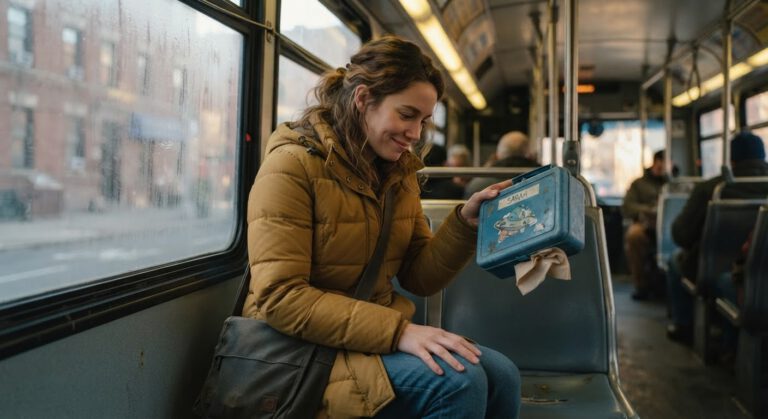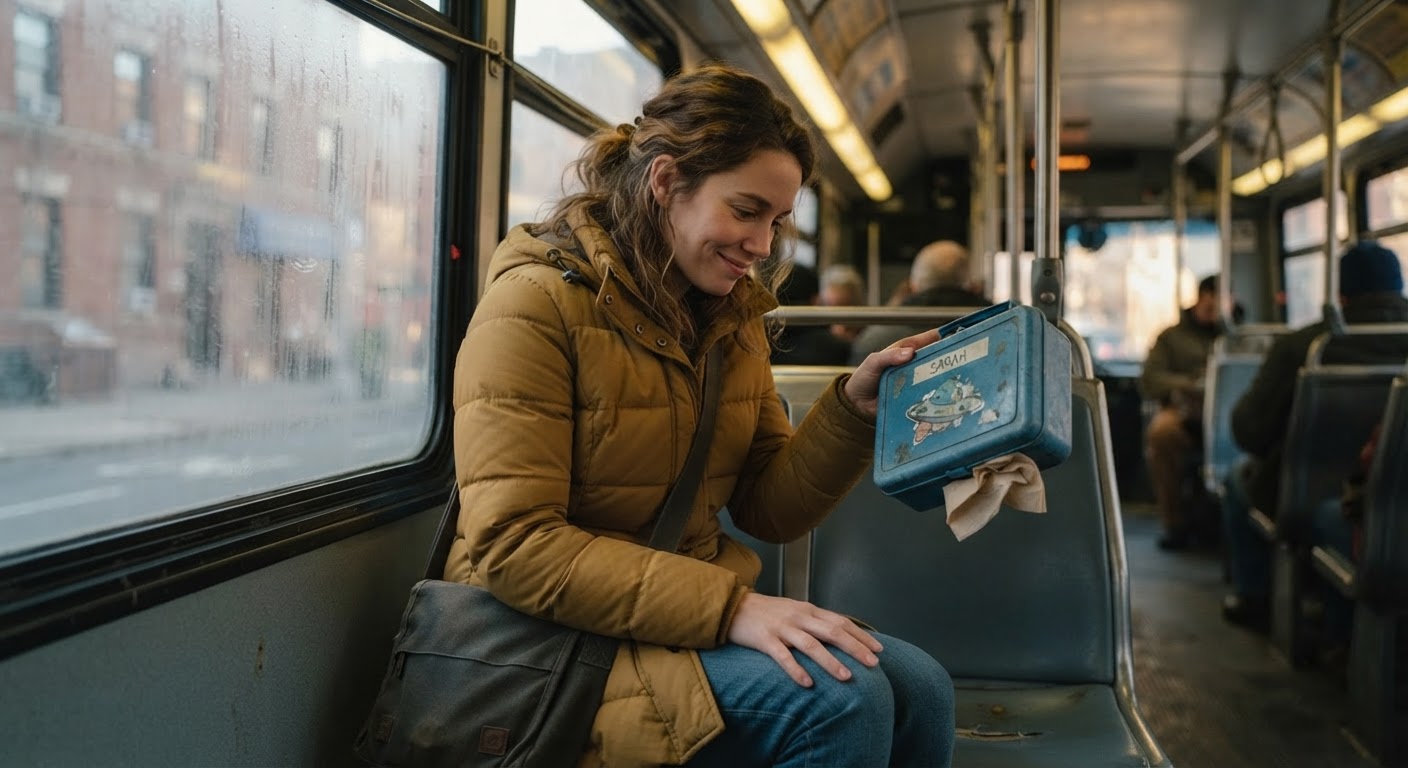
Elena Morales was used to finding things on the number 14 bus. Umbrellas. Gloves. Phone chargers. Once, somebody had even left an entire birthday cake on the back seat. But she had never seen anyone write a warning on a lunchbox.
She turned it over. The blue plastic was scratched and faded. One corner had been repaired with silver tape. There was something else written beneath the name. A phone number.
Elena pulled out her phone and dialed it. No answer. She tried again. Still nothing. The bus driver was already preparing to leave the stop.
„Excuse me,“ Elena said. „Someone left this.“
The driver glanced at it.
„Put it in lost and found.“
„Do you know Mateo?“
The driver shook his head.
„Probably a kid.“
Elena looked at the lunchbox. She thought about leaving it, but then she remembered something her mother used to say. If someone has taken the time to write their name on something, they probably really need it back. So Elena sat down. She would wait until the driver finished his route. It was inconvenient – she was already late for work.
But she waited. Twenty minutes later, a boy came running onto the bus. He couldn’t have been more than eleven. His hair was soaked from the rain. His backpack was hanging from one shoulder. He looked terrified.
„Did you find a blue lunchbox?“
Elena stood.
„This one?“
The boy’s face changed instantly.
„Yes!“
He grabbed it with both hands.
„Thank you.“
„You called the number?“
„My mom’s at work.“
„Is everything okay?“
The boy hesitated but he nodded.
„Yeah.“
But Elena could tell he was lying.
He held the lunchbox against his chest like it contained something precious.
Elena smiled.
„You don’t have to tell me.“
The boy looked relieved.
Then he opened the lunchbox.
Inside were three sandwiches.
A small apple.
A folded napkin.
And a plastic container with a handwritten label:
DINNER — FOR MOM
Elena looked at him.
The boy quickly closed the lid.
„She doesn’t eat at work,“ he said quietly.
Elena understood.
„Your mom forgot her lunch?“
„No.“
He looked down.
„She gives hers to me.“
Elena didn’t know what to say.
The boy continued.
„She says she’s not hungry.“
The bus suddenly felt very quiet.
Elena sat beside him.
„What if we get your mom some food?“
The boy shook his head.
„We can’t.“
„Why?“
„Because she doesn’t like people helping.“
Elena smiled gently.
„Sounds like she’s proud.“
The boy nodded.
„Very.“
„What is your name?“
„Mateo.“
„I’m Elena.“
Mateo looked at her.
„Are you going to tell her?“
„Tell her what?“
„That I put dinner in my lunchbox.“
Elena smiled.
„I don’t think she needs to know.“
Mateo looked relieved.
Then he stood.
„I have to go.“
„School?“
He nodded.
„You’re going to be late.“
„I know.“
He started toward the door.
Then he turned.
„Thank you for waiting.“
Elena watched him disappear into the rain. She assumed that was the end of the story, yet it wasn’t.
That afternoon, Elena couldn’t stop thinking about the lunchbox. She worked at a small neighborhood grocery store. Usually, she enjoyed the job. She knew most customers by name, knew which elderly customers needed help carrying their bags, which parents came in five minutes before closing because they had forgotten something for dinner. But that day, every time she saw someone buying bread, she thought about Mateo.
At closing time, Elena had an idea. She walked into the manager’s office.
„Can I ask you something?“
Her manager looked up.
„That depends.“
Elena laughed.
„Do we throw away the bread that doesn’t sell?“
„Usually.“
„What about the produce?“
„Some of it.“
„And the yogurt?“
„If it’s close to its date, yes.“
Elena leaned against the door.
„What if we gave it away?“
Her manager frowned.
„To whom?“
„Families who need it.“
„We’re a grocery store, Elena.“
„I know.“
„And food costs money.“
„I know.“
She paused.
„But we’re already throwing some of it away.“
Her manager stared at her.
„How much are you talking about?“
„I don’t know.“
„Then find out.“
So Elena did.
For the next week, she kept a notebook. Every evening, she recorded what the store was throwing away. Bread, fruit, vegetables, dairy products, packaged meals.
Nothing spoiled.
Just food that was no longer perfect enough to sell.
At the end of the week, Elena showed her manager the numbers.
They were shocked.
The store was throwing away more than they realized.
Her manager rubbed his forehead.
„What do you want me to do?“
„Let me organize it.“
„Organize what?“
„A community food shelf.“
He laughed.
„Where?“
Elena pointed toward a small empty space beside the employee entrance.
„Right there.“
They started with one shelf. Elena bought labels with her own money.
She wrote:
TAKE WHAT YOU NEED.
LEAVE WHAT YOU CAN.
NO QUESTIONS.
At first, almost nobody used it. Then one evening, an elderly man took a loaf of bread. The next morning, he came back with a jar of homemade jam. A woman left canned beans. Someone brought rice. Another customer donated baby food. Within a month, the little shelf had become a small pantry.
People started calling it The Neighbor Shelf.
Elena kept everything organized. She made sure nothing expired.
She created a simple system. Food that needed refrigeration went into one section. Dry goods went into another. Fresh produce was placed out each afternoon.
The store manager eventually gave her a small storage room.
„You’ve created a problem,“ he told her.
Elena looked worried.
„What kind?“
„Now people keep asking if they can donate.“
She smiled.
„That’s a terrible problem.“
He laughed.
„It is.“
But there was one problem Elena couldn’t solve.
She didn’t know where Mateo lived. She wanted to tell him about the shelf. She wanted him to know his mother didn’t have to pretend she wasn’t hungry. But she didn’t have his phone number. She had the number written on the lunchbox. It belonged to his mother. Elena didn’t want to invade their privacy.
So she waited. Two weeks passed. Then, on a Thursday afternoon, the grocery store became unusually busy. A delivery truck had arrived late. Customers were waiting. Employees were rushing.
Elena was carrying a box of apples toward the stockroom when she heard someone call her name.
„Elena?“
She turned.
Mateo was standing near the entrance. His mother was beside him, she looked exhausted.
„Hi,“ Elena said.
Mateo smiled.
„I told my mom about you.“
His mother stepped forward.
„I wanted to thank you.“
„You don’t have to.“
„I do.“
She looked at Elena.
„You waited for him that morning.“
„He was worried about the lunchbox.“
She smiled.
„He was worried about me.“
Elena didn’t respond.
Mateo’s mother looked embarrassed.
„I lost my job two months ago.“
Elena nodded.
„I’ve been taking whatever temporary work I can find.“
She glanced toward Mateo.
„I didn’t want him to know how bad things were.“
Mateo looked at the floor.
His mother continued.
„I thought if I skipped meals, he wouldn’t notice.“
„He noticed,“ Elena said gently.
The woman laughed despite herself.
„Apparently.“
Elena looked toward the employee entrance.
„Can I show you something?“
She led them to the Neighbor Shelf.
Mateo stared. His mother stopped walking.
„What is this?“
Elena explained.
The woman looked at the shelves, then at Elena.
„You did this?“
„No.“
Elena shook her head.
„The neighborhood did.“
There were tears in the woman’s eyes.
„I can’t take charity.“
Elena smiled.
„Then don’t.“
The woman looked confused.
„Take what you need.“
She looked at the sign.
„And when you’re able, leave something for someone else.“
The woman stood quietly for a moment. Then she picked up a loaf of bread. Mateo picked up an apple. Neither said anything.
They didn’t need to.
The Neighbor Shelf grew. So did Elena’s responsibilities. Soon, nearby stores started asking how they could participate.
A bakery donated bread, a restaurant donated meals at the end of the night, a farmer brought boxes of vegetables every Saturday.
Elena realized something important.
The shelf didn’t work because she was especially generous. It worked because she had created a way for ordinary people to help each other without embarrassing anyone. That distinction mattered.
People didn’t want to be treated like problems. They wanted to be treated like neighbors.
Six months later, Elena received an email from the city. Someone had nominated the Neighbor Shelf for a local community award.
Elena almost deleted the email. She assumed it was one of those things that required paperwork and speeches. Then she read the final paragraph. The city wanted to fund three additional community food shelves based on her model.
Elena stared at the screen.
Her manager walked past.
„What’s wrong?“
„Nothing.“
„You look terrified.“
Elena turned the computer around. He read the email, then he smiled.
„Well.“
„What?“
„I think you’ve got yourself a project.“
The first new shelf opened at a laundromat.
The second opened at a community center.
The third opened inside a small apartment building.
And something unexpected happened. People began adding other things. A woman left children’s books. Someone donated school supplies. A retired electrician offered free repairs to elderly residents. A college student posted a sign offering help with job applications.
The shelves stopped being just about food.
They became places where people could quietly say:
I have something you might need.
And someone else could answer:
Thank you.
A year after Elena found Mateo’s lunchbox, she was invited to speak at a community meeting. She hated public speaking. Her hands were shaking. There were more than one hundred people in the room. She stood behind the microphone.
„I don’t really know why I’m here,“ she began.
Everyone laughed.
She smiled.
„I’m not an organizer. I’m not a politician. I’m not a social worker.“
She looked down.
„I’m just the person who noticed we were throwing away food.“
She paused.
„And I think that’s what most of us do sometimes.“
The room became quiet.
„We look at a problem and think it’s too big.“
She looked toward the back of the room. Mateo was there, his mother was beside him.
„So we do nothing.“
Elena smiled.
„But sometimes the first step isn’t solving the whole problem.“
She thought about that rainy morning.
„It’s noticing the one thing you can do.“
The audience applauded.
But Elena wasn’t looking at them, she was looking at Mateo. He held up something blue – his old lunchbox.
After the meeting, Mateo walked over.
„Do you remember this?“
Elena laughed.
„I could never forget it.“
He opened the lid.
Inside was a sandwich. An apple. And a folded note.
Elena opened it.
It said:
FOR SOMEONE WHO NEEDS IT.
She looked at him.
„What is this?“
„My mom and I made it.“
Mateo pointed toward a table near the entrance. There were several packed lunches sitting there.
„We started making them every Friday.“
„For who?“
Mateo shrugged.
„Whoever needs one.“
Elena looked at his mother.
She smiled.
„We’re doing what you taught us.“
Elena shook her head.
„I didn’t teach you that.“
His mother smiled.
„Maybe not.“
She looked at the lunchbox.
„But you showed us.“
Years later, Elena would still think about the blue lunchbox. Not because it had led to an award. Not because the city had expanded the program. Not because the grocery store eventually became one of the largest food-donation points in the neighborhood.
She remembered it because, for a few minutes on a rainy Monday morning, she had chosen not to rush past someone else’s problem. She had waited. That was all.
She hadn’t known Mateo’s family. She hadn’t known what was happening behind their front door. She hadn’t known how many people were quietly skipping meals. She certainly hadn’t planned to create a community project. She had simply returned a lunchbox.
But sometimes life doesn’t ask you to solve everything. Sometimes it puts one small thing directly in front of you. A person who needs help. A problem everyone else has learned to ignore. A little opportunity to make someone’s day less difficult. And sometimes, if you stop long enough to notice, that little thing becomes the beginning of something much bigger.
The next Monday morning, Elena was walking past the Neighbor Shelf when she saw a new note taped to the front.
She stopped.
It read:
TAKE WHAT YOU NEED.
LEAVE WHAT YOU CAN.
AND IF YOU CAN’T LEAVE ANYTHING YET, THAT’S OKAY.
Elena smiled.
Because sometimes kindness doesn’t come back to you as money. Sometimes it comes back as a community. And sometimes the person you help today becomes the person who helps someone else tomorrow.
ENDING:
Elena never found out exactly how many people had been helped by the Neighbor Shelf. She stopped counting after the number became too large.
But every Friday, Mateo still packed one extra lunch. Not because his family was struggling anymore. They weren’t. His mother had found steady work. Mateo was doing well in school. And their refrigerator was full.
He packed the extra lunch because he remembered what it felt like to wonder whether there would be enough. And Elena knew that was the real reward. Not that one forgotten lunchbox had changed her life.
But that one small act had taught a child something he would carry for the rest of his.
When you have enough, you don’t have to ask who deserves help. You simply notice who needs it.
SHAREABLE TAKEAWAY:
You don’t have to solve the whole world’s problems—sometimes changing one person’s day is enough to start something bigger than you ever imagined.
Disclaimer. This content was generated using an AI system.
Über den Autor